Researchers from Queensland University of Technology have reported a major advance in carbon nanotube-based thermoelectric materials, opening new opportunities for flexible wearable electronics, body-heat energy harvesting and sustainable waste-heat recovery technologies.
The study, published in Angewandte Chemie International Edition, introduces a new molecular design strategy that helps prevent carbon nanotubes from aggregating, a long-standing challenge that has limited their thermoelectric performance for more than two decades.
The research was led by Mrs Shanshan Zhou under the supervision of Professor Zhi-Gang Chen, Lead Chief Investigator of the ARC Research Hub for Zero-emission Power Generation for Carbon Neutrality and Director of the ARC ZeroPC Hub. The work forms part of the Hub’s Theme 1 research program, which focuses on advancing high-performance thermoelectric materials and devices for zero-emission power generation and energy-harvesting applications.
Carbon nanotubes are lightweight, flexible and electrically conductive, making them highly attractive candidates for wearable thermoelectric devices. However, their strong tendency to clump together can reduce material uniformity, disrupt charge transport and limit device performance. The new molecular strategy developed by the QUT team helps keep nanotubes well dispersed while preserving their ability to transport electricity efficiently.
Professor Chen said the breakthrough addresses one of the most persistent barriers in carbon nanotube thermoelectrics and demonstrates the importance of molecular-level materials design.
“For many years, carbon nanotubes have been recognised as promising materials for wearable thermoelectric systems because they are flexible, lightweight and electrically conductive. However, their tendency to aggregate has severely limited their performance,” Professor Chen said.
“Our new molecular design strategy provides a pathway to control how carbon nanotubes interact with each other, allowing us to improve their dispersion while maintaining efficient electrical transport.”
Lead author and QUT PhD researcher Mrs Shanshan Zhou said the work offers a new way to unlock the potential of carbon nanotubes for flexible energy-harvesting technologies.
By using specially designed molecules to control interactions between nanotubes, the researchers achieved a new benchmark in carbon-based thermoelectric performance and demonstrated the material’s potential in flexible devices capable of generating electricity from body heat.
The research team further demonstrated the material in a flexible thermoelectric device that could harvest electricity from body heat while maintaining durability after repeated bending and folding. This points to future possibilities in battery-free wearable electronics, health monitoring sensors, smart textiles, flexible sensors, the Internet of Things and sustainable portable devices.
The work aligns closely with the ARC ZeroPC Hub’s mission to develop zero-emission power generation technologies by converting otherwise wasted heat into useful electricity. It also contributes directly to Hub Theme 1 by advancing the design of next-generation thermoelectric materials with improved performance, flexibility and device compatibility.
Professor Chen said the discovery complements the Hub’s broader research program in flexible thermoelectric materials, device engineering and clean-energy translation.
“At QUT and through the ARC ZeroPC Hub, we are developing technologies that can convert waste heat into useful electricity. This work represents another important step towards sustainable, flexible energy systems that can power future wearable and portable electronics,” Professor Chen said.
The research team included Shanshan Zhou, Dr Xiao-Lei Shi, Dr Meng Li, Dr Wenyi Chen, Dr Tianyi Cao, Nan-Hai Li, Dr Min Zhang, Professor Prashant Sonar, Dr Qian Liu and Professor Zhi-Gang Chen from the ARC Research Hub for Zero-emission Power Generation for Carbon Neutrality, the QUT School of Chemistry and Physics, and the QUT Centre for Materials Science.
The research was supported by the Australian Research Council and QUT’s Capacity Building Professor Program.
Read the full study, “Radical-Mediated Dispersion Breaks Aggregation Limits in Carbon Thermoelectrics”, in Angewandte Chemie International Edition
Source: Adapted from QUT News, “QUT breakthrough unlocks long-sought performance barrier for carbon nanotubes”. Image credit: QUT News.
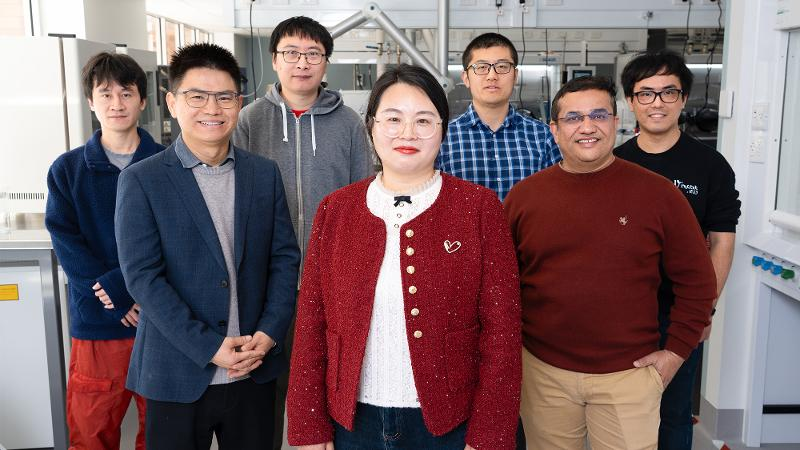
Top photo: From left, Nan-Hai Li, Professor Zhi-Gang Chen, Dr Xiao-Lei Shi, Mrs Shanshan Zhou, Dr Meng Li, Professor Prashant Sonar and Dr Wenyi Chen.