Researchers at Queensland University of Technology (QUT) have published a new review article outlining how screen printing could help transform thermoelectric technology from laboratory-scale innovation into scalable manufacturing.
Published in Soft Science, the article, “Screen printing as a scalable manufacturing approach for thermoelectric devices”, provides a manufacturing-focused roadmap for screen-printed thermoelectric devices. The work highlights how printable thermoelectric materials and device architectures could support future applications in wearable electronics, the Internet of Things (IoT), intelligent sensors, industrial waste heat recovery, and solid-state cooling.
The review was authored by Wenyi Chen, Meng Li, Xiao-Lei Shi and Zhi-Gang Chen from QUT’s School of Chemistry and Physics, the ARC Research Hub for Zero-emission Power Generation for Carbon Neutrality, and the QUT Centre for Materials Science.
Thermoelectric technologies can directly convert heat into electricity, or use electricity for solid-state cooling. While major advances have been made in improving the performance of thermoelectric materials, translating these materials into scalable, cost-effective and reliable devices remains a key challenge for commercial deployment.
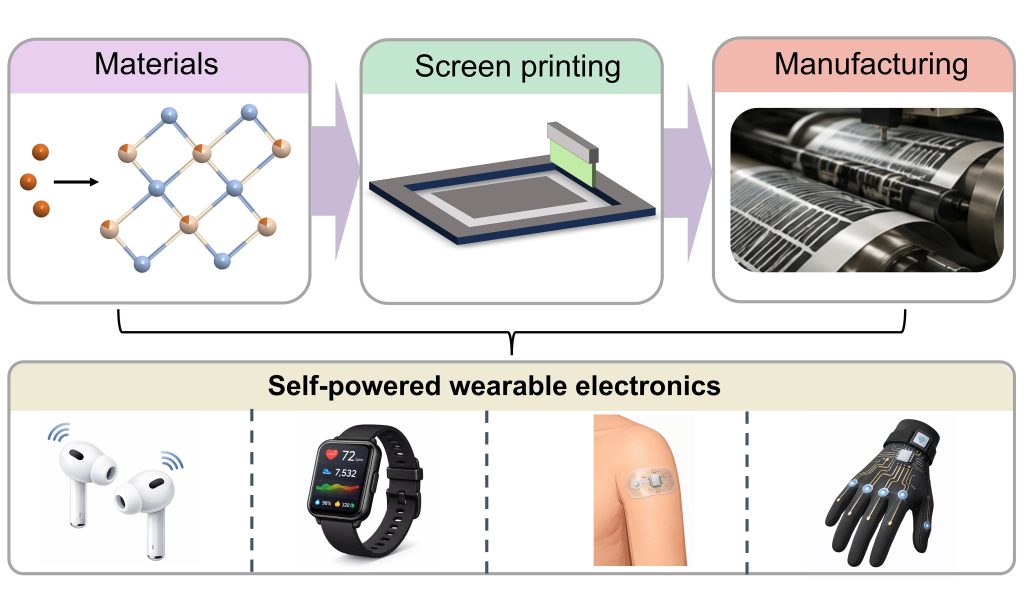
The new review identifies screen printing as a promising manufacturing platform to bridge this gap. As a mature, low-cost and scalable technique already used in printed electronics, sensors, photovoltaics and other industries, screen printing offers a practical pathway for producing thermoelectric devices with controlled thickness, pattern design and substrate compatibility.
Professor Zhi-Gang Chen, Director of the ARC Research Hub for Zero-emission Power Generation for Carbon Neutrality and a researcher in QUT’s School of Chemistry and Physics and Centre for Materials Science, said the review represents the next stage in translating thermoelectric research into real-world technologies.
“Our previous studies demonstrated that screen printing can produce high-performance flexible thermoelectric devices using scalable manufacturing processes,” Professor Chen said.
“This review moves beyond individual material breakthroughs to provide a comprehensive manufacturing framework that connects materials design, printing technologies, device architectures and application requirements. We hope it will help accelerate the transition of thermoelectric technology from laboratory research to commercial manufacturing.”
The publication builds on a series of internationally recognised advances from the QUT team. In 2024, the researchers reported in Science a nanobinder-enabled screen-printing strategy for high-performance flexible inorganic thermoelectric devices, demonstrating that scalable printing can support strong thermoelectric performance, mechanical flexibility and manufacturing compatibility. More recently, the team reported in Nature Communications new advances in flexible thermoelectric materials and devices, further strengthening the foundation for industrially manufacturable printed inorganic thermoelectrics.
Unlike conventional reviews that focus mainly on improving material performance, the new article places manufacturing at the centre of thermoelectric development. It systematically evaluates printable inorganic and organic thermoelectric materials, compares film-based and bulk-like device architectures, and proposes a decision-making framework to guide the selection of materials, printing processes and device configurations for different applications.
The review also highlights key research priorities for industrial-scale manufacturing, including quantitative printability metrics, process–structure–performance relationships, interface engineering, long-term reliability, and manufacturing-informed device design.
This publication represents the latest milestone in QUT’s long-term research program on printed thermoelectric technologies. By connecting materials innovation with scalable manufacturing strategies, the review provides a strategic roadmap for advancing next-generation energy harvesting and solid-state cooling technologies that could contribute to more sustainable electronics, improved energy efficiency and Australia’s growing advanced manufacturing sector.
Read the full article: https://www.oaepublish.com/articles/ss.2026.82
Source: Adapted from the Soft Science publication “Screen printing as a scalable manufacturing approach for thermoelectric devices”. Images, if used, should be credited to the original publisher or copyright holder as indicated in the article.