Researchers from Queensland University of Technology have reported a targeted copper doping strategy that significantly improves the thermoelectric performance of germanium telluride, a promising material for converting waste heat into electricity.
The study, published in Nature Communications, demonstrates a new solid solution treatment that enables copper ions to be incorporated into specific atomic positions within GeTe-based thermoelectric materials. This targeted approach helps overcome structural limitations that have previously restricted the material’s energy conversion performance.
The work was led by first author Ms Yongqi Chen, with Professor Zhi-Gang Chen, Lead Chief Investigator of the ARC Research Hub for Zero-emission Power Generation for Carbon Neutrality and Director of the ARC ZeroPC Hub, together with researchers from QUT’s School of Chemistry and Physics, the QUT Centre for Materials Science, and the ARC ZeroPC Hub.
This research forms part of the Hub’s Theme 1 program, which focuses on the discovery, design and optimisation of high-performance thermoelectric materials and devices for zero-emission power generation. By improving the atomic-scale control of thermoelectric materials, the study directly supports Theme 1’s goal of developing efficient materials capable of converting otherwise wasted heat into useful electricity.
Germanium telluride is widely studied for thermoelectric applications because of its strong potential for heat-to-electricity conversion. However, its performance can be limited by defects and atomic arrangements within the crystal structure. The QUT team addressed this challenge by using a targeted copper ion diffusion strategy to guide copper ions into host lattice sites, rather than allowing them to occupy less controlled interstitial positions or form unwanted impurities.
Professor Zhi-Gang Chen said the work demonstrates how precise atomic-scale design can unlock higher thermoelectric performance.
“Germanium telluride has strong potential for converting waste heat into electricity, but its performance is often limited by structural defects and how atoms are arranged within the material,” Professor Chen said.
“In this study, we used a solid solution strategy to guide copper ions into specific positions in the crystal structure. This targeted approach allows us to reduce defects and improve the material’s ability to generate electricity from heat.”
The new material achieved a thermoelectric figure of merit of 2.3, compared with 1.5 for the previous version of the material, representing an improvement of more than 50 per cent.
Ms Yongqi Chen said the targeted doping strategy provides a new pathway for developing more efficient energy conversion materials.
“By incorporating copper ions into specific points in the crystal structure, we were able to produce significantly more power than similar materials have achieved before,” Ms Chen said.
The research highlights the importance of defect control, ion diffusion and lattice-site engineering in advancing next-generation thermoelectric materials. It also strengthens QUT and the ARC ZeroPC Hub’s leadership in developing materials technologies that can support energy efficiency, waste heat recovery and Australia’s transition towards carbon neutrality.
Professor Chen said the discovery aligns closely with the Hub’s mission to translate advanced materials research into zero-emission power generation technologies.
“The ARC ZeroPC Hub brings together leading researchers and industry partners to develop technologies that can convert wasted heat into useful electricity,” Professor Chen said. “This work is a strong example of how fundamental materials design can contribute to practical clean-energy solutions.”
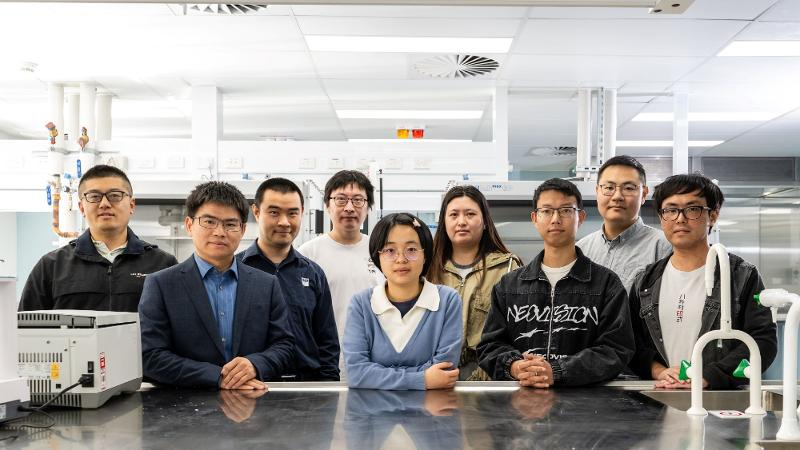
The research team included Ms Yongqi Chen, Professor Zhi-Gang Chen, Dr Meng Li, Dr Xiaodong Wang, Dr Wenyi Chen, Siqi Liu, Min Zhang, Dr Wanyu Lyu, Nan-Hai Li, Dr Han Gao, Professor Wei-Di Liu and Dr Xiao-Lei Shi from the ARC Research Hub for Zero-emission Power Generation for Carbon Neutrality, QUT’s School of Chemistry and Physics, and the QUT Centre for Materials Science.
Read the full paper, “Copper ion diffusion by solid solution treatment advancing GeTe-based thermoelectrics”, in Nature Communications
Source: Adapted from QUT News, “Thermoelectric performance boost through targeted strategy”, published on 15 August 2025. Image credit: QUT News / QUT / ARC ZeroPC Hub.